
- Art & Design
- Computing
- Design & Technology
- Early Years Foundation Stage (EYFS)
- English
- French
- Geography
- History
- Mathematics
- Music
- Physical Education
- PSHE
- Religious Education
- Science
At Beverley Minster C of E Primary School, we want every child to become a confident, resilient and enthusiastic mathematician. We believe that all children can achieve in mathematics when they are provided with high-quality teaching, appropriate challenge and the support they need to develop secure mathematical understanding.
Our mathematics curriculum is carefully sequenced so that pupils build on prior learning and develop the knowledge, skills and understanding they need for the next stage of their education. We place a strong emphasis on developing fluency, reasoning and problem-solving, enabling children not only to know mathematical facts and methods, but to understand and apply them.
Our Intent
We aim for pupils to:
- develop a secure understanding of number and the key mathematical concepts outlined in the National Curriculum;
- become fluent and accurate in essential mathematical facts and procedures;
- develop their ability to reason mathematically, explain their thinking and justify their answers;
- apply their mathematical knowledge to solve problems in a range of contexts;
- make connections between different areas of mathematics and recognise the relevance of maths in everyday life;
- develop resilience and perseverance when faced with mathematical challenges;
- use appropriate mathematical vocabulary to communicate their ideas;
- become increasingly independent and confident in their mathematical thinking.
Our Implementation
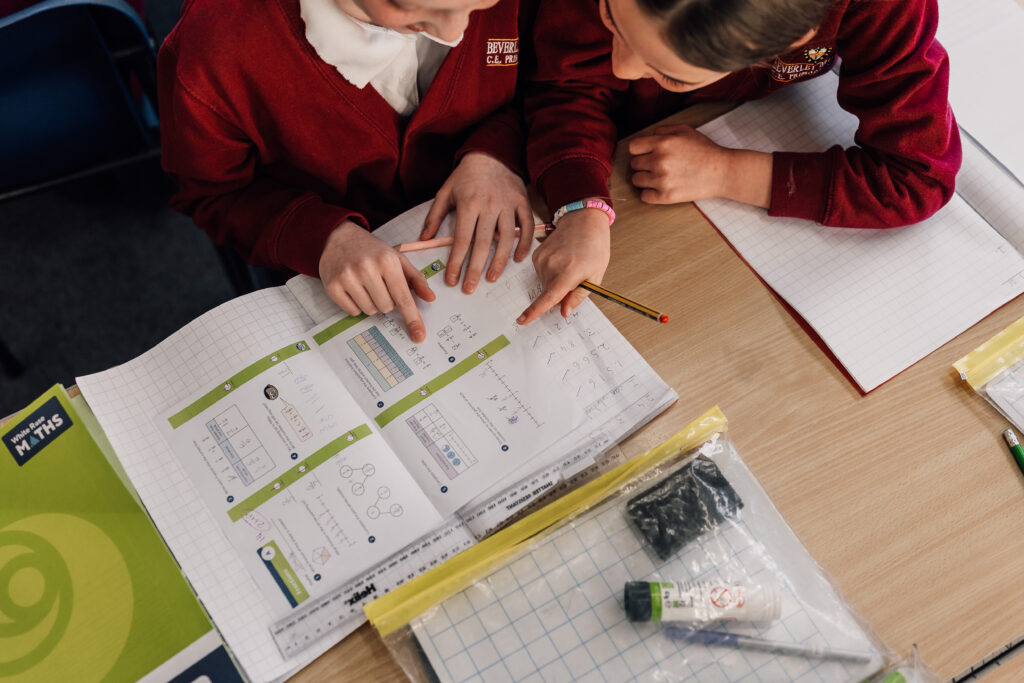
We use White Rose Maths as the foundation of our mathematics curriculum. The White Rose sequence and resources support teachers in planning learning that builds progressively from pupils’ prior knowledge.
White Rose booklets are used alongside teacher-created resources and alternative planning and teaching materials, including resources from the National Centre for Excellence in the Teaching of Mathematics (NCETM). Teachers use their professional knowledge of their pupils to adapt and supplement resources where appropriate, ensuring that teaching responds to the needs of each class.
Our curriculum is therefore supported by a consistent whole-school approach while allowing teachers to make informed decisions about the most effective way to teach particular mathematical concepts.
Fluency, reasoning and problem-solving
Fluency, reasoning and problem-solving are developed throughout our mathematics curriculum. Pupils are given regular opportunities to practise and secure key mathematical facts and procedures, while also being encouraged to explain their methods, identify patterns, make connections and justify their thinking. Reasoning and problem-solving are embedded within teaching rather than treated as separate areas of mathematics. Pupils are encouraged to apply their knowledge in different contexts and to develop strategies for tackling unfamiliar problems.
Developing mathematical understanding
We use a concrete-pictorial-abstract (CPA) approach to support pupils in developing a deep understanding of mathematical concepts. Children are encouraged to use practical equipment and manipulatives, visual representations and mathematical models before moving towards increasingly abstract representations and efficient written methods. These approaches are used flexibly according to the mathematical concept being taught and the needs of individual pupils. Our aim is for children to understand the mathematics behind the methods they use, rather than simply memorising procedures.
Retrieval and developing long-term learning
Regular retrieval opportunities help pupils revisit and strengthen previously taught knowledge. Flashback 4 is used several times each week to provide opportunities for pupils to recall and apply learning from previous units and year groups. This supports the development of fluency and helps teachers identify areas where further teaching or practice may be needed.
Early mathematics and Mastering Number
In Foundation Stage, we use the NCETM Mastering Number programme. Mastering Number supports children in developing strong foundations in number, including subitising, counting, number composition and fluency with key number facts. This early focus on developing secure number sense provides an important foundation for pupils’ mathematical learning throughout the rest of their primary education. Year 1 also use this to supplement and reinforce their teaching of White Rose to further support the basic maths fluency.
Multiplication and times tables
We place a strong emphasis on developing pupils’ fluency and understanding of multiplication and division facts throughout Key Stage 2. In Year 4, pupils have a particular focus on developing secure recall of multiplication and division facts in preparation for the statutory Multiplication Tables Check (MTC).
Times Tables Rock Stars is used alongside classroom teaching to provide pupils with regular opportunities to practise their multiplication facts and develop confidence and accuracy. This digital practice complements, rather than replaces, the teaching and understanding of multiplication in the classroom.
Assessment and responsive teaching
Assessment is an integral part of our mathematics teaching. Teachers use a combination of ongoing formative assessment, White Rose end of unit assessments and NFER termly assessments to develop an understanding of pupils’ knowledge, identify misconceptions and monitor progress.
Teachers continually assess pupils through questioning, observation, discussion and their written work. This information is used to adapt teaching and identify where pupils require further support, practice or challenge. Where pupils need additional support, this may include pre-teaching, same-day intervention, targeted small-group work, additional practice or scaffolding within lessons. Pupils who demonstrate secure understanding are provided with opportunities to deepen their learning through reasoning, problem-solving and applying their knowledge in increasingly challenging contexts. Our approach aims to ensure that misconceptions are identified and addressed promptly and that pupils develop secure foundations before moving on to new learning.
Inclusion
We are committed to ensuring that every pupil can access and succeed in mathematics, including pupils with SEND and those who require additional support. Teachers adapt resources, representations, questioning, explanations and the level of scaffolding according to pupils’ individual needs. Practical equipment, visual representations, worked examples, guided practice and targeted intervention are used where appropriate.
At the same time, we maintain high expectations for all pupils and provide opportunities for children to develop greater depth through reasoning, problem-solving and making connections between mathematical ideas.
Our Impact
The impact of our mathematics curriculum is reflected in pupils’ developing mathematical knowledge, fluency, reasoning and ability to apply their understanding.
We evaluate the effectiveness of our mathematics curriculum using a range of evidence, including:
- pupils’ work and their ability to apply knowledge across different contexts;
- ongoing teacher assessment;
- White Rose and NFER assessment information;
- pupils’ ability to recall and retain previously taught knowledge;
- statutory assessment outcomes, including the Year 4 Multiplication Tables Check and end-of-key-stage assessments;
- discussions with pupils about their mathematical learning and use of mathematical vocabulary;
- monitoring of teaching, learning and curriculum coverage.

This information helps us to identify strengths, address gaps and misconceptions, and determine priorities for further development.
Ultimately, we want pupils to leave Beverley Minster as confident mathematicians who have secure mathematical foundations, can explain their thinking, solve problems and apply their knowledge independently in school and in everyday life.
Supporting Mathematics at Home
Parents and carers can play an important role in helping children develop confidence and fluency in mathematics.
We encourage families to practise key mathematical facts regularly and to look for opportunities to use mathematics in everyday situations, such as cooking, shopping, telling the time, measuring and working with money.
Further information and resources to support mathematics at home can be found below.