
- Art & Design
- Computing
- Design & Technology
- Early Years Foundation Stage (EYFS)
- English
- French
- Geography
- History
- Mathematics
- Music
- Physical Education
- PSHE
- Religious Education
- Science
Writing at Beverley Minster CE Primary School
At Beverley Minster CE Primary School, we use the Talk for Writing approach to develop confident, independent writers with a love of language. Our carefully planned writing curriculum builds progressively on prior learning, enabling every child to write effectively for a range of purposes, audiences and subjects. We recognise the importance of building strong foundations in language, communication, reading and writing as secure English skills enable all children to access a broad and balanced curriculum; providing the foundations for success in life.
Oracy is at the heart of our approach. Through storytelling, discussion, role play and debate, children develop the vocabulary, confidence and language skills needed to communicate their ideas before applying them to their writing. By hearing, rehearsing and exploring language, pupils gain a deeper understanding of different text types and become more successful writers.
Reading also plays a vital role in our writing curriculum. Children are immersed in high-quality texts, rich vocabulary and a wide range of genres, helping them understand how effective writing is crafted and inspiring them to develop their own authorial voice.
In the Early Years, children build the foundations for writing through mark making, storytelling, language-rich play and the development of fine motor and handwriting skills. Writing opportunities are woven throughout, using the indoor and outdoor learning environment, and children are encouraged to take pride in their work from the very beginning.
As pupils move through Key Stage 1 and Key Stage 2, they progress from imitation, to innovation, and finally to independent application. Through shared and guided writing, children internalise language patterns before applying their knowledge independently across the curriculum.
Our aim is for every child to leave Beverley Minster CE Primary School as a confident, creative and resilient writer, equipped with the skills to communicate effectively and achieve their full potential.
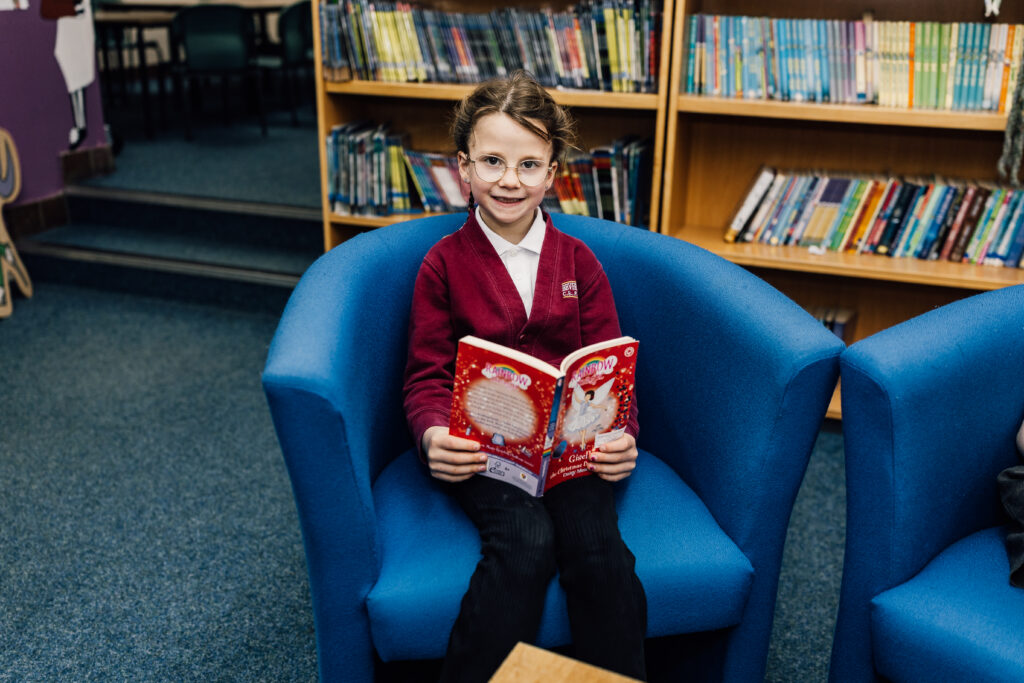
Reading Intent
At Beverley Minster CE Primary School, we aim to develop a love of language, reading and books. We believe that reading creates a firm foundation for children to be able to access learning, build confidence and independence. We are ambitious for our children and we want all our pupils to become confident readers who can independently read a range of books and texts. We encourage all children to develop an enthusiasm and enjoyment for reading to continue through to adult life regardless of ability or background.
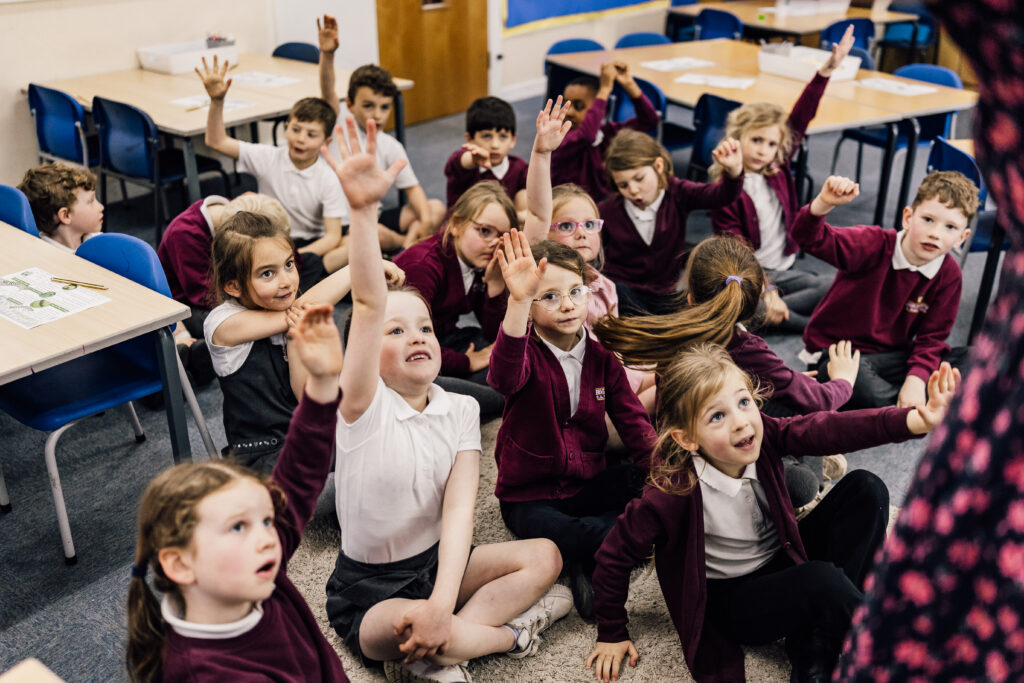
We follow the National Curriculum for Reading and believe that:
“Reading widely increases pupils’ vocabulary because they encounter words they would rarely hear or use in everyday speech. Reading also feeds pupils’ imagination and opens up a treasure house of wonder and joy for curious young minds.” (NC14).
We intend for our reading curriculum to progress throughout the school so that children will know more, remember more and understand more. We want them to be able to build on the knowledge and skills they obtain at each stage and become successful readers.
We also want our children to access a comprehensive reading curriculum that enables them to develop their understanding of the world and apply their knowledge and skills across all areas of the curriculum. This in turn will teach our children how to play a positive and successful role within our society, both as a child and as an adult within the future.
Reading Implementation
Early reading skills and a phonics based approach to reading In Foundation Stage and Key Stage One
We teach a systematic, synthetic approach to phonics to develop the children’s reading skills. We follow The Little Wandles phonics programme with each phase building on the skills and knowledge of previous learning.
We teach phonics daily in EYFS and Year 1 and extend phonics support through to further year groups with fidelity to the Little Wandles scheme. These sessions focus on developing reading, writing, speaking and listening skills. Phonics is a way of teaching children to read and write. It is the ability to hear, identify, and manipulate sounds and understand the link between the sound (phoneme) and the way it is written (grapheme). Phonics is also taught beyond Year 1 (where appropriate) and the knowledge the children have gained previously is reinforced in conjunction with their reading, writing and spelling skills.
Guided Reading
We teach reading through Guided Reading as a whole class, small groups and with individuals, reading a wide range of texts as a class. Guided Reading texts and focus develop in complexity as the children move through the school. This encourages more in-depth exploration of a text and its features, ensuring that children build on their knowledge and skills as they progress.
Guided Reading focuses on developing the following skills:
Accuracy:
Pupils learn to decode and read words correctly applying their phonics knowledge.
Automaticity:
Pupils develop an ability to read words automatically and at an appropriate pace.
Prosody:
Pupils learn to read aloud or silently with the appropriate use of stress, intonation and expression. We believe this develops pupils reading accuracy and comprehension and they learn to vary volume, phrasing, smoothness and pace reflecting emotion, emphasis and tone,
As children develop these skills in reading they become increasingly engaged with the text and read with enthusiasm across all areas of the curriculum. We also use online reading to encourage a deeper understanding of comprehension using programmes such as Reading Plus.
Reading Schemes
The children read a range of books from our Little Wandles scheme. This is a progressive system that links with the stage of phonics each child is currently accessing. Later in the school, we also use Oxford Owls progressive colour banded book scheme in school and at home to support and develop their phonic and reading skills. We have a range of books that includes fiction and non-fiction. Children are encouraged to read from different genres and read at home as well as in school. The reading scheme compliments our phonics progression and books are chosen carefully to ensure the scheme reinforces the phonics knowledge learnt at each stage.
Reading for Pleasure
We have a varied programme of enrichment to develop reading for pleasure across school, encouraging children to select books from their own interests and broaden the range of authors and texts they choose to read. All children have the opportunity to select books from our school library and our class book areas. Whole school events such as ‘Readathon’ and ‘World Book Day’ instill a love of reading and enjoyment of books throughout the school. These events further enable staff and parents to engage with the children’s reading.
Phonics Intent
At Beverley Minster CE Primary school we are passionate about ensuring all children become confident, enthusiastic readers and writers and will develop a love for accessing texts in all their forms. We believe that phonics is the key to this and it will develop the foundations in which they become more fluent in both reading and writing. We intend for children to have regular exposure to a systematic approach of progression in phonics that challenges and supports their learning, regardless of background or starting point. We want our children to know more and remember more as they progress so they can apply their knowledge and skills across the curriculum with increasing complexity. These foundations for learning not only hold the keys to the rest of the curriculum but also to their self esteem and development of “being our best at Beverley Minster.”
Implementation
At Beverley Minster CE Primary School, phonics is taught daily across EYFS and Key Stage 1 as well as interventions across Key Stage 2. We use a programme called Little Wandles which is a systematic, synthetic phonics approach. This is designed to teach children how to read through the act of decoding and blending. It teaches the children the link between the sounds of our language (phonemes) and the written representation of these sounds (graphemes) or the spellings of the sounds contained in the English language.
Children are taught as a class and in small groups. These are assessed every half term to identify pupil’s gaps in learning and to inform their planning and teaching. This enables the teacher to monitor and identify which pupils are ‘keeping up’ with the pace of teaching and ensure additional support is given to those pupils who require it. Interventions focus on GPC recognition, oral blending and blending for reading. This is either in quality first teaching in small groups or 1:1.